
Why TVs break during transport
Modern TVs are lightweight, thin, and fragile by design. While this improves image quality, it makes screens highly vulnerable when moved between locations.
Common causes of damage during transport include:
❌ Side impacts and vibration inside vehicles
❌ Flexing of the panel when screens are laid flat or unsecured
❌ Knocks during bump-in and bump-out at venues
❌ Inadequate padding in soft cases or improvised packaging
Even short trips can result in cracked panels, dead pixels, or internal component damage — issues that often don’t appear until the screen is powered on.
For AV professionals and event teams, a single damaged TV often means:
👎 Costly replacements
👎 Missed event deadlines
👎 Loss of client confidence

How TV packer cases prevent damage
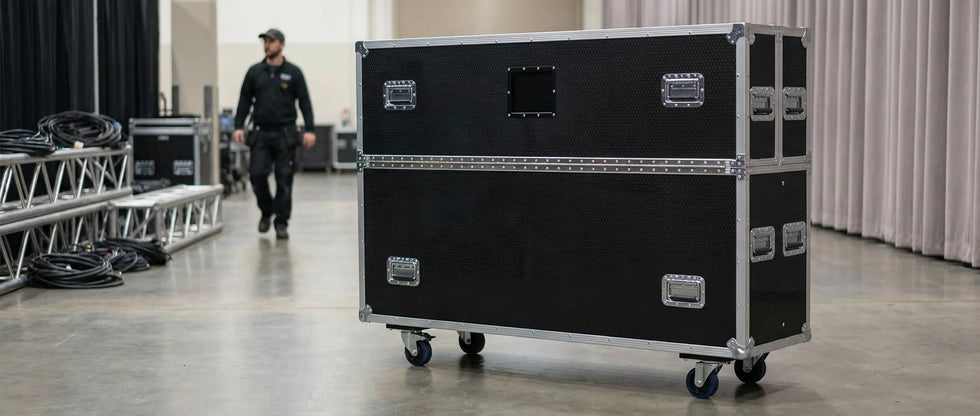
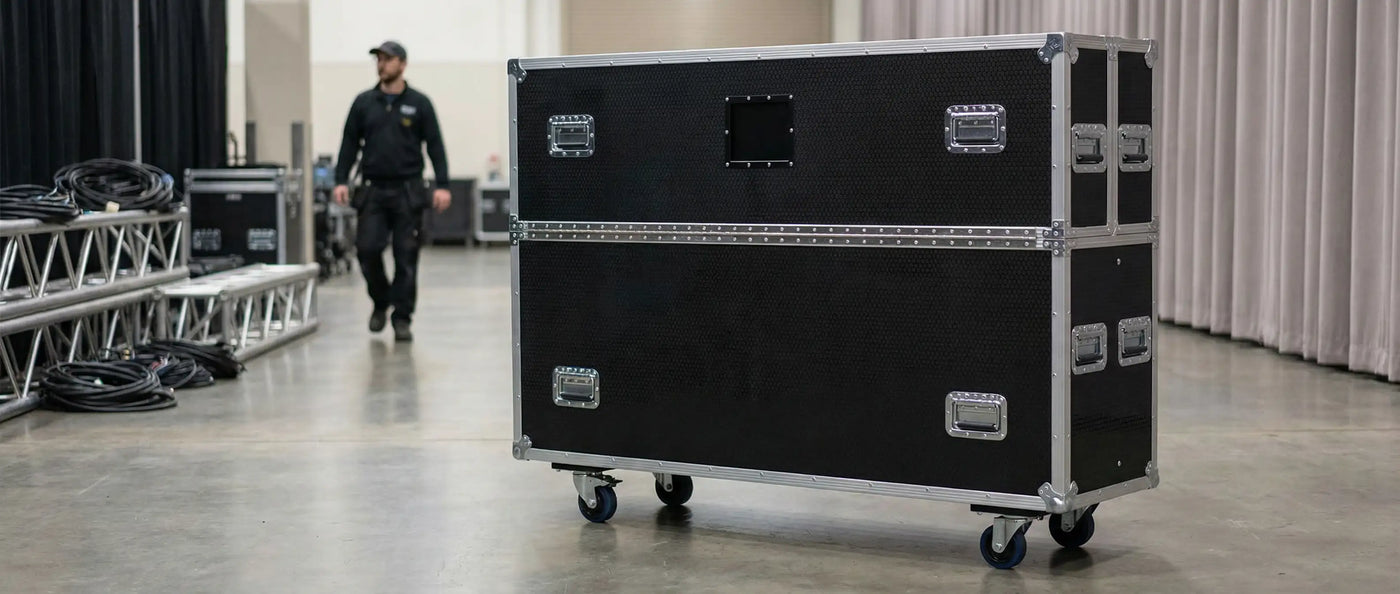
TV packer cases are purpose-built to protect screens during frequent transport.
They work by combining:
✅ Rigid plywood construction to absorb impacts and prevent flexing
✅ Internal foam padding that cushions the screen and reduces vibration
✅ Upright transport design, keeping screens in their safest orientation
✅ Heavy-duty castors for controlled movement through venues
✅ Reinforced corners, latches, and handles for repeated professional use
Every design choice is made to handle the realities of event transport, not just storage.
Unlike cardboard packaging or soft bags, TV packer cases are designed for real-world event conditions — trucks, ramps, elevators, loading docks, and tight backstage spaces.
The result: significantly reduced breakage risk, even when screens are moved frequently.
Who TV packer cases are for
-
![]()
AV production companies
Transporting TVs between events.
-
![]()
Hire and rental houses
Managing high-turnover screen fleets.
-
![]()
Corporate event teams
Handling roadshows and conferences.
-
![]()
Exhibition and trade show suppliers
Moving displays between venues.
-
![]()
Education and institutions
Storing and relocating shared screens.


FAQs
Can TVs be transported flat instead of upright?
Can TVs be transported flat instead of upright?
Transporting TVs flat significantly increases the risk of screen flex and internal damage, especially for larger displays. These cases are designed for upright transport, which keeps weight evenly distributed across the panel and reduces stress on the screen.
For frequent transport, upright positioning is strongly recommended.
Can I transport two TVs in one case?
Can I transport two TVs in one case?
Yes. Dual TV packer cases are designed to safely carry two screens, separated by internal padding to prevent contact and vibration. This is a common setup for AV companies and hire houses looking to reduce transport space while maintaining protection.
Always ensure both screens are within the recommended size range for the case.
Do I need a different case for different TV models?
Do I need a different case for different TV models?
TV packer cases are sized by screen size, not brand or model. As long as your TVs fall within the supported size range and external dimensions, they can be transported safely.
If you’re using unusually thick screens or displays with rear-mounted hardware, check measurements before selecting a case.
Are TV packer cases suitable for touring and frequent events?
Are TV packer cases suitable for touring and frequent events?
Yes. TV packer cases are built for repeated professional use, including touring, weekly events, and high-turnover hire environments. The construction and hardware are designed to withstand regular loading, transport, and venue handling.
They’re not intended for one-off moves — they’re built for long-term, repeated use.
Will a TV packer case protect against vibration during transport?
Will a TV packer case protect against vibration during transport?
TV packer cases use foam padding and rigid construction to reduce vibration and absorb impacts during transport. While no case can eliminate all movement, they dramatically reduce the risk compared to cardboard packaging or soft cases.
This is especially important for longer drives and rougher transport conditions.
Can I store TVs in the case when not in use?
Can I store TVs in the case when not in use?
Yes. Many customers use TV packer cases for both transport and storage, particularly in warehouses, schools, and hire environments. Upright storage inside a case also helps protect screens from accidental knocks when not in use.
Are these cases suitable for loading into trucks and vans?
Are these cases suitable for loading into trucks and vans?
Yes. TV packer cases are designed for real-world transport environments, including trucks, vans, ramps, and loading docks. Heavy-duty castors make it easier to manoeuvre cases through venues and backstage areas.
How do I choose between the 50”–65” and 70”–80” cases?
How do I choose between the 50”–65” and 70”–80” cases?
Choose based on the largest TV you need to transport, not the smallest. If your screens are close to the upper limit of a size range, moving up to the larger case provides extra clearance and protection.
When in doubt, a slightly larger case is safer than a tight fit.
Are TV packer cases worth it compared to using original packaging?
Are TV packer cases worth it compared to using original packaging?
Original cardboard packaging is designed for one-time shipping, not repeated handling. TV packer cases are purpose-built for frequent transport, significantly reducing damage risk, downtime, and replacement costs over time.
For regular events or professional use, they’re a far more reliable solution.